Setup
PoC Prerequisites (GCP)
Note: For teams deploying licensed Zipline in their own GCP project (PoC or production). On AWS? See PoC Prerequisites (AWS). Self-hosting Chronon or using the public demo? Skip this page.
Zipline runs Spark and Flink on Google Kubernetes Engine (GKE) in a dedicated GCP project colocated with your data—no existing Spark cluster needed, and data scientists use only the Chronon Python API. Your engineer runs Terraform paired with Zipline (~90 min, mostly terraform apply).
Scoping
Align on these inputs first so Zipline can size the environment:
- Use cases: 1–2 models covering batch features, real-time features, and online serving.
- Scale: Approximate table sizes, stream throughput, and online latency/QPS targets.
- Region: GCP region of your data (e.g., BigQuery datasets or Cloud Storage buckets).
- Machine types: Preferred Compute Engine machine types for sizing regional vCPU quotas.
Deployment Overview
- Zipline provides: Access to
zipline-ai/infrastructure, Docker Hub token, and release version. - Terraform creates: Regional GKE cluster, Cloud SQL Postgres, Bigtable,
zipline-<customer>-*Cloud Storage buckets, Workload Identity service accounts/IAM bindings, and a public L4 load balancer.
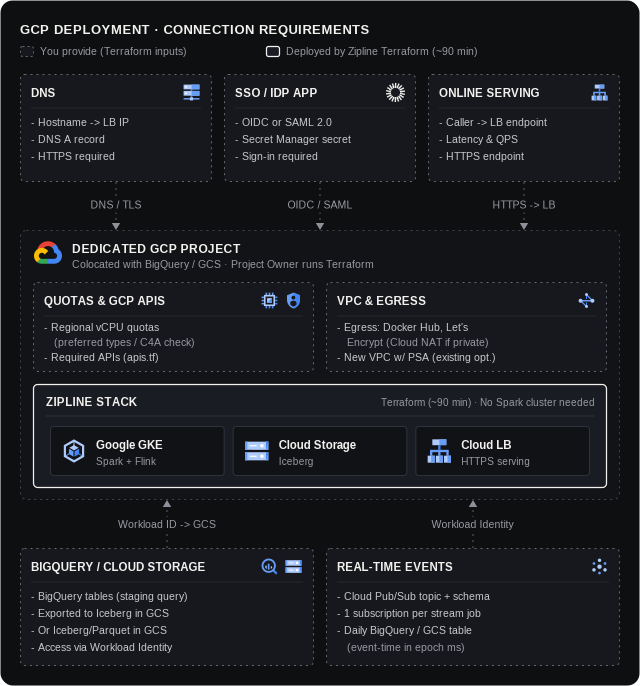
What You Provide
- GCP project & IAM: Dedicated GCP project with billing (same region as your data) + Owner-level rights to run Terraform. Terraform enables the required APIs automatically (
gcp/zipline-orchestration/apis.tf), or your platform team can pre-enable them (gcp.enable_apis = false). - Terraform state: Private, versioned Cloud Storage bucket.
- Compute quotas & machine types: Regional vCPU quotas on your preferred machine types (Zipline sends target quotas once volumes are known). Default compute pools use Arm C4A; flag regions without C4A availability (e.g.,
us-west1,us-west2) beforehand for overrides. - VPC & egress: New VPC (with
pods/servicessecondary ranges and Private Service Access for Cloud SQL) by default, or an existing VPC/subnet with those configured. Outbound access to Docker Hub and Let's Encrypt (if using private nodes, provide Cloud NAT). - DNS: Hostname (e.g.,
zipline.<your-domain>), pointed via an A record to the deployed load balancer IP (Let's Encrypt or bring-your-own cert). - Batch data: BigQuery tables (exported to Iceberg via staging queries) or Iceberg/Parquet tables in Cloud Storage.
- Real-time events: Pub/Sub topic with a Pub/Sub schema (one subscription per streaming job), plus a daily Iceberg table through yesterday (event time in epoch ms—e.g., landed in BigQuery and exported via staging query).
- Sign-in (SSO): OIDC/SAML 2.0 (Okta, Entra ID, etc.) or Google/GitHub OAuth app + allowed emails/domains, stored in a Secret Manager secret in the cluster project. HTTPS and sign-in are required (Authentication).
- Online serving: Calling service for the load balancer endpoint (plus latency/QPS targets).
Roles
| Role | Time | Responsibilities |
|---|---|---|
| Deployment lead (1) | ~30 min/wk | Scope, success criteria, access requests. |
| Cloud, platform & data engineer | ~1.5 days | GCP project, quotas, IdP app, DNS, Terraform deploy, and BigQuery/Pub/Sub access. |
| Data scientists (1–2) | Few hrs/wk | Feature logic, Chronon Python API (private Git repo), output review. No GCP IAM access needed. |
Next Steps
- Set catalog and storage paths in
teams.py(Project Setup). - Sign in via CLI (CLI Authentication).
- Author, backfill, deploy, and serve features (Quickstart).